


What if you could write a great blog post or landing page that was super relevant to your industry and the needs of your target audience and was very effective at converting readers into customers (or at least subscribers)? How would you drive traffic to that particular blog post again and again instead of letting that post get lost in your archives?
Part of the answer is evergreen content, but that’s just one piece of the SEO puzzle. While making sure your topic is evergreen is a great way to ensure that content remains relevant and shows up in searches again and again, topic clusters allow you to actively drive traffic to that particular piece of content by creating other pieces of content that lead back to that post or page. These are called topic clusters and the post or page to which they all lead is called the pillar content because it’s the pillar holding up the cluster of content on that one topic.
Table of Contents
How Do Topic Clusters Improve Your SEO?
Now that we know what topic clusters are, let’s take a quick look at how they work. The short answer is: backlinks.
Backlinks
Backlinks are when a website links to a particular page or blog post on your website, and they are essential for your SEO strategy. An external backlink is when another website links back to yours, while an internal backlink is when you create a link on a blog post or page of your own website that links back to another post or page on your own website. Google knows you have ulterior motives when it comes to linking back to your own content, so it tends to prioritize external links when factoring backlinks into your search rankings, but that doesn’t mean internal links don’t count. When used strategically, internal links can be a great way to both drive traffic to a particular post or landing page while also improving your search rankings.
In order to use internal backlinks the right way, you need to make sure the content leading to the pillar page is relevant to the content on the pillar page. Relevance is a key ingredient in SEO and you’d better believe Google has figured out a way to measure relevance, so don’t just link to a random page on your website because you need a call to action but you don’t know what it should be. Have a pillar page you can direct content to that will finish converting those leads into customers.
Organic Traffic
Don’t underestimate the value of organic traffic. If you have a new blog post that ranks well for relevant searches and succeeds in leading people back to your pillar content, that’s organic traffic going to your pillar content. Do that with multiple blog posts and you can end up driving a significant amount of traffic to your pillar content just from the website visitors who click on your internal backlinks.
How to Create Topic Clusters
Now that we know what topic clusters are and how they work, let’s talk about how you can implement them to improve your website’s search rankings.
Choose the Topic of Your Topic Cluster?
First, you have to determine the topic of your pillar content to which you will be driving traffic from all those other pieces of content. What is one topic you could talk about all day? All week?
Since this content will have to be relevant (and will ideally rank well in online searches) for months, if not years to come, you need to make sure it’s an evergreen topic because there’s no point in driving traffic to a piece of content that won’t be relevant in a few months.
Research Your Topic
It’s never enough to think of a topic and start creating content around it. You need to make sure that 1) there’s an audience for that content (i.e. people are actively searching for it); and 2) the internet has not already been overloaded with content on that topic. When you research your search terms, your keyword research tool will provide a search volume (the average number of searches that keyword gets each month) and an SEO competition score, which gives you an idea of how difficult it will be to try to rank for that particular keyword. Ideally, you want a keyword that gets a decently high search volume and a low competition score.
Since you’ll be creating a lot of pieces of content to lead back to this pillar page, it can help to target a search term that’s broad enough to include multiple related topics. For example, “financial strategy” is not only a great keyword to use on its own, it’s also a broad topic that includes multiple components of financial planning.
Once you find a keyword that is both sufficiently broad to encompass multiple related topics, and evergreen, and a keyword worth targeting, you need to start researching the related topics you can create around that one piece of content. I always recommend starting with the related keywords generated by your keyword research tool, shown here:
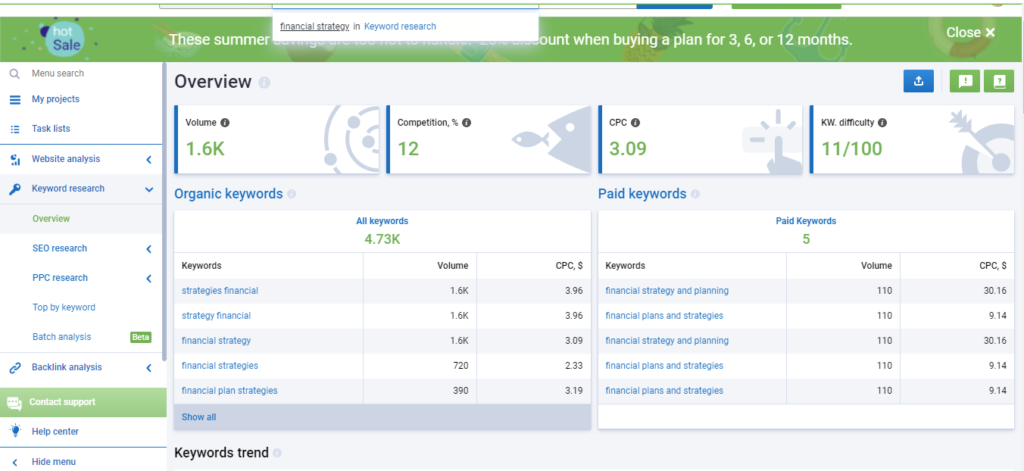
Don’t think these are your only options. Feel free to explore some of the related keywords and see what your keyword research tool generates as related keywords for your related keywords. It can be a bit of a rabbit hole, but it should be narrowed down by the fact that you have a strategy behind your keyword research that fits into your overall content strategy.
Another tool I love is called Answer the Public, which lets you enter a search term and it generates all the most commonly asked questions online using or related to that search term. You can click “data” to view the results as a list, but the initial image the tool provides demonstrates how you can create clusters within your topic cluster based on the kinds of questions your target audience is asking. Here’s what Answer the Public generated when I entered “financial strategy”:

That’s a lot of topics! And they’re all separated by the kinds of questions people tend to ask using that particular search term. Again, you should always do your keyword research before deciding on a topic for any of your content, whether it’s a pillar post or cluster content, but these questions collected by Answer the Public are a great place to start because Answer the Public just tells you the questions people are already asking around a particular topic. You just have to make sure enough people are asking the question and that the competition isn’t too stiff.
Ask Google
Finally, you can always ask Google what questions people are asking Google around a particular topic. Google loves to suggest questions when you start entering a search term, so start by entering your topic cluster into Google’s search bar. Preface your search with “how” or “why” and see what Google generates as a suggested list of questions around that particular topic. For example, here’s what I came up with when I did that with “financial strategy”.
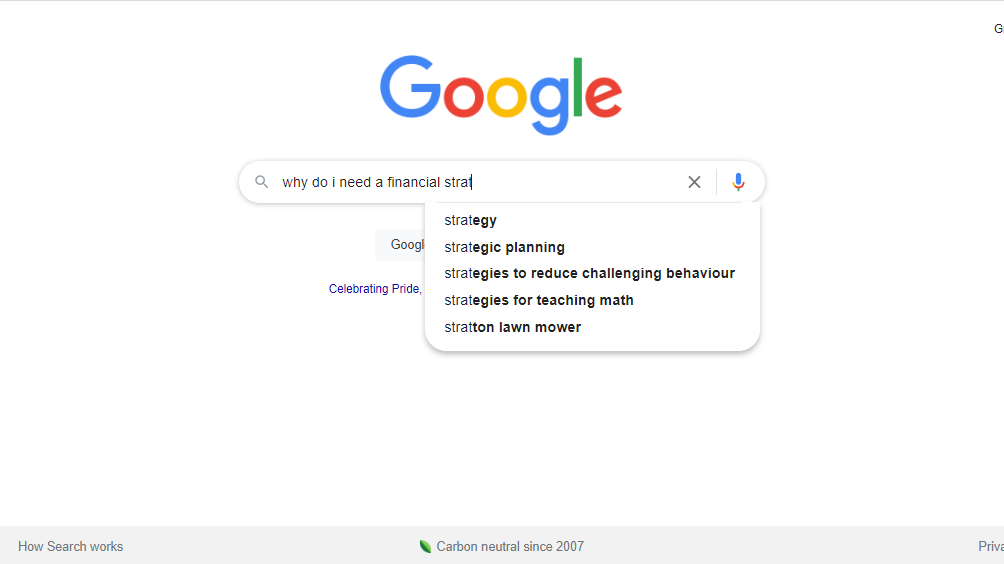
Obviously, not all of these search terms are going to be relevant to your topic cluster, but at least the top few results give you some ideas as to the questions people are asking using that search term.
Organize Your Keywords
By the time you’ve done all this research, you should have a ton of keywords you can use throughout your pillar content, as well as all your cluster content. Not all of those keywords will stand on their own as a topic within your topic cluster, but they could still be worth using in the body and/or subheadings of your content, so the first thing you need to do is sort out which keywords can stand on their own as topics and which ones are better off supporting your target keywords.
Next, you’ll want to filter your keywords by intent. For example. “What is a financial strategy” and “why do I need a financial strategy” both have similar search intents, so rather than creating duplicate content for each search term, you should create one piece of content that uses both search terms.
Don’t Repeat Yourself
It’s time to sit down and actually write your pillar page and cluster content, but this can be easier said than done. While it’s true that each piece of content needs to fit under one giant, umbrella topic, it’s important not to repeat yourself because that devalues your content. Not only does Google prioritize original content over duplicate content, but by covering the same details in multiple pieces of content, you’re not providing as much value to the reader as you could if you made sure each piece of content was unique.
Organizing your keywords, as mentioned in the previous section, is the first step to making sure you don’t repeat yourself in multiple pieces of cluster content, but you also need to make sure that each piece of cluster content dives deep into its particular subtopic. Surface-level information is for amateurs and it’s not going to provide enough detailed information to convince Google (or your readers) that you’re a true authority on the subject, so make sure each subtopic is specific enough to be a subtopic of your pillar content, but also broad enough to warrant an entire blog post or web page.
Update Existing Content
If all this sounds overwhelming and you can’t imagine finding the time to research, create, optimize, and distribute all this content, you’re not alone. First of all, you can always hire us to handle one or more aspects of your topic clusters, or you could look through the content you already have and see if there’s something there that can be used as either a pillar page and/or cluster content. It might turn out that all you need to do is create a pillar page and include some links to that page in some of your existing blog posts and you’re halfway there.
It’s also important to remember that you don’t have to publish all your cluster content at the same time. In fact, you’d probably be better off spreading it out and publishing a piece one month, another piece the next month, etc. One of the benefits of evergreen content is that it’s always relevant, so you can continue to distribute that content on social media, on your newsletter, etc., but it also means you can continue creating cluster content around that pillar page for months, or even years to come.
If you found this content useful and would like to receive more of it, you can sign up for our newsletter in the space below. You can also see what we’re up to by following us on LinkedIn, Twitter, YouTube and Facebook.
