


I was recently doing some SEO research, and when I found a blog post that appeared to answer my question, I checked the date the blog post was published because I wanted to make sure the information in there was still relevant. Google is constantly changing their algorithm, so an SEO strategy that might have worked a few years ago, or even a few months ago, won’t necessarily be as effective if used today.
But it would have been a different story if I had been searching for something like “how to find a good business attorney in my area” or “what is financial planning?” Those are both questions with answers that don’t really change, so I would have been less concerned with the date the information was published.
The content people create and publish to answer those questions is called evergreen content because people can continue to refer to it (and it can continue to show up in online searches) for years after it was first published. Compare that to all the time and effort you put in to creating and distributing content that’s outdated after a few months (or even a few weeks), and it’s clear why you should spend most of your content marketing resources creating and optimizing evergreen content.
Let’s talk about why evergreen content is so important to your content strategy and some of the best methods you can use to implement it in your content strategy.
Table of Contents
- Why You Need to Include Evergreen Content in Your Content Strategy
- How to Find Evergreen Topics
- How to Create Evergreen Content
- How to Make the Most of Your Evergreen Content
Why You Need to Include Evergreen Content in Your Content Strategy

As mentioned above, evergreen content produces a much higher ROI than timely content because you can continue to drive traffic to (and convert leads from) evergreen content for years after it was published. Timely content has its benefits, but it also has its limitations, so while I absolutely recommend covering the timely topics in your industry, it’s also important to remember to devote the majority of your resources to evergreen content and make sure you’re getting the most out of it, which I’ll get to a little later in this post.
Evergreen content is also great for your SEO. It’s important to remember that Google’s algorithm takes a while to index and categorize new content, which means it is very difficult to get your new blog post to show up in online searches the day after publication unless you do absolutely everything right from an SEO perspective and your website already has a very high domain authority. Even then, timely content will have a limited lifespan in the world of online searches. Either people will stop searching for an answer to that particular question or Google will replace your post with newer content that’s perceived as more relevant because of the more recent publication date.
By contrast, evergreen content has time to spare. It can wait to be indexed and categorized by Google so the algorithm can figure out which searches should be matched with your content, and then it can show up in those searches over and over and over again.
While timely content tends to suffer in the rankings the older it gets, evergreen content actually benefits from having been around a while, especially if you’re consistently publishing new, high-quality content on your website and doing everything else right from an SEO perspective. It takes time to build trust, and that goes for Google’s algorithm as much as it does for real human beings, and by sticking around and putting in the work, Google will recognize you as an authority in your industry, and by extension, your content as trustworthy.
Evergreen content can also help drive traffic to the rest of your website. Let’s say your new blog post on the latest update in your industry hasn’t taken off yet, but your evergreen blog post from a few years ago is still showing up in online searches. Someone who finds the older, evergreen content, reads it, and likes what they see, is more likely to stick around and explore your website. That might mean looking at some of your landing pages, or it could mean looking over your other blog posts, including your newer, more timely content.
Additionally, having a page or blog post on your website that ranks well for certain search terms can help improve the domain authority of your whole website, so there’s really no reason not to invest in evergreen content.
That being said, the downside to evergreen keywords is that, while people might be conducting searches using those keywords for years to come, your competition could get wise to the fact that it’s a valuable keyword, leading to more competition over time, which will make it increasingly difficult for you to rank for that particular keyword. All the more reason to start targeting those evergreen keywords sooner, rather than later so you can get ahead of the competition.
Now that we know why evergreen content is so important, let’s talk about how you can incorporate evergreen content into your content strategy.
How to Find Evergreen Topics
It’s one thing to say you need evergreen content, and another thing entirely to know which topics will still be relevant years from now and which ones will fall by the wayside. Nevertheless, there are some tried-and-true strategies you can use to make sure your content never goes out of date.
FAQs
Some evergreen topics are obvious. You know which questions you’ve been asked over and over, and keep getting asked no matter how long you’ve been in business. Those are all great examples of evergreen topics, so if you haven’t already covered them on your blog, start there.
Keywords
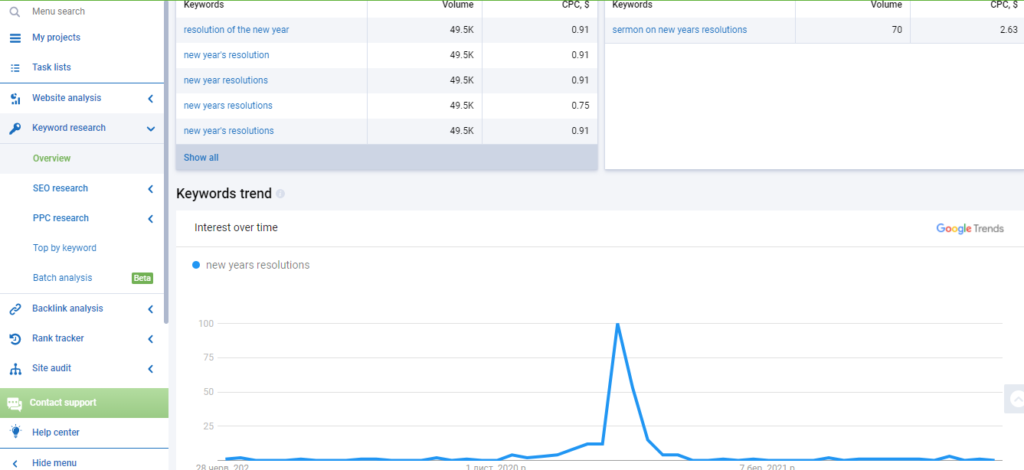
Most keyword research tools give you a lot of information about any keyword you research, including the “interest over time” which is usually displayed as a line graph in which you can see how the number of searches a particular keyword gets tends to go up and down over time. The graph usually shows that keyword’s trend for the past year, and the timely keywords will usually have a spike, followed by a decline. For example, here’s what the keyword trend looks like for “new year’s resolution”.
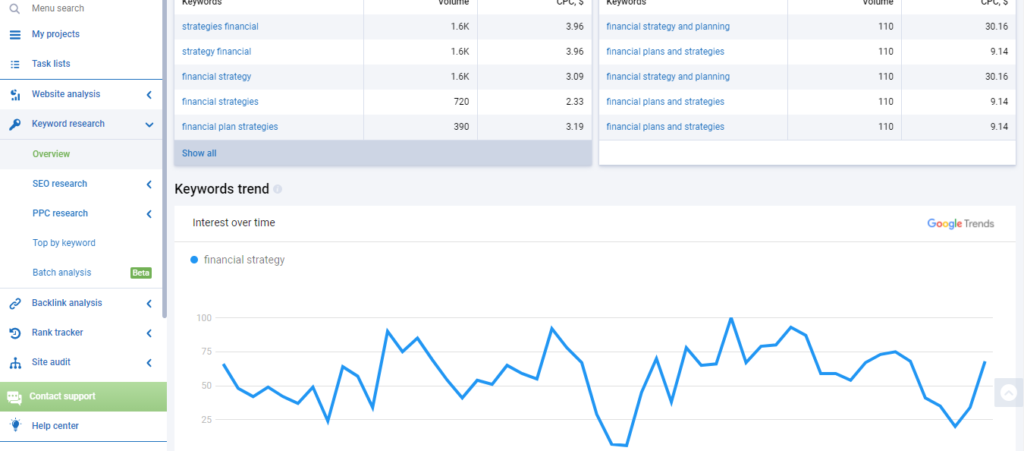
By contrast, an evergreen keyword might have peaks and valleys, or even a steady (or not-so-steady) increase in interest over time, meaning it’s getting more searches now than it was getting a few months ago. For example, here’s what the keyword trend looks like for “financial strategy”, which is a more evergreen keyword.
Both of these are important to remember when it comes to checking the search volume of any keyword you’re researching. Remember that the search volume is the average number of searches per month, but that same keyword could have a much higher search volume one month compared to other months, which could throw off the number of average searches per month.
Holidays
Holidays are actually an example of timely content, but here’s the thing about holidays: they come around every year. So, while someone might not be conducting a search for new year’s resolutions in July, they’ll probably be searching for them in January of next year … and the year after that … and the year after that. This means you can write one blog post about new year’s resolutions related to your industry and use it again and again every January.
To give that blog post an extra boost, you can take down the original post, update it with the new year in the title and throughout the content (and maybe make some other updates if certain recommendations from last year are no longer as relevant) and republish it. The new publication date will fool both Google and readers into thinking it’s a brand-new blog post, when it’s really the same content you published last year with slightly different packaging. That way, instead of spending hours writing and editing a new blog post, you can devote that time to making and achieving your own new year’s resolutions.
How to Create Evergreen Content
Finding topics that are ideal for evergreen content is a necessary first step, but the topic is just the beginning of your content creation process. Once you know what you’re writing about, there are different ways you can write about the topic to make it more evergreen.
Make Sure Your Angle Is Evergreen
You can have an evergreen topic with a timely angle. While there can be short-term value in providing a “hot take” on any given issue, those “hot takes” are usually timely, so before you spend any time or effort explaining your “hot take” make sure it’s a perspective people will still care about years from now.
Use Evergreen Language
Using terms like “last month” or “this year” can date a post and make it feel timely, even if the topic is evergreen. Remember that, while Google might “read” your title and subtitles first, it does get around to “reading” the rest of your content, and if it feels timely, that could affect the rankings.
The same goes for the real people who find your evergreen content. They might not look for a publication date when they first find your website, but if they see a reference to a specific point in time, that might prompt them to go looking for a publication date, and possibly to wonder whether the content is still relevant.
How to Make the Most of Your Evergreen Content
While creating evergreen content is one way to improve your SEO, there are other things you can do to give that content a boost, including:
Distribute Your Evergreen Content

SEO is kind of a Catch-22 in that you want to improve your website’s SEO in order to drive traffic to your website, but at the same time, Google monitors the organic traffic going to your website, and if it sees your website is already getting visitors, that will improve your SEO. One of the ways you can drive traffic to your website before it ranks for any search term is by talking up your blog post online. Let your newsletter subscribers know you have a new blog post. Share it on social media.
While you should always be doing this as soon as you publish a new blog post, one of the things that makes evergreen content so valuable is the fact that you can share those posts on social media again and again to both increase your social media footprint and drive traffic to your website. It’s a win/win!
Repurpose Your Evergreen Content
I’ve always been a big fan of repurposing your content because 1) there’s no point in reinventing the wheel after you’ve already found something that works; and 2) you can get much more mileage put of any given topic by talking about it in as many different mediums and on as many different platforms as possible.
This goes double for your evergreen content. Not only should you write a blog post about it, but you should make a video about it and use the audio from that video to make it into a podcast episode. Then you can share your blog post, your video, and your podcast episode on social media. You can turn it into an infographic and share that on social media. You can talk about your evergreen topic in your newsletter.
All that content can lead people back to your website, so once you’ve found an evergreen topic, milk it for all it’s worth.
Update Your Evergreen Content
Even your evergreen content could probably use some updating every once in a while, so check in on it and make sure it’s still relevant. If you’re too busy to write a blog post this week/month, or if you’ve hit a writer’s block, go back to some of your evergreen posts and see if one of them could use an update. Then you can republish it, which will help drive even more traffic to that post.
If you found this content useful and would like to receive more of it, you can sign up for our newsletter in the space below. You can also see what we’re up to by following us on LinkedIn, Twitter, YouTube, and Facebook.
Whether you need help creating evergreen content, or just maintaining a regular blogging schedule, we can help.
