


For Christmas one year my mom bought my four-year-old cousin whatever the hottest toy for four year olds was that year and my cousin was ecstatic. My aunt (not the kid’s mom, but another aunt) was utterly baffled because she had never heard of the toy and my cousin’s enthusiasm took my aunt completely by surprise. My aunt asked my cousin what shows she watched where they advertise such toys and the poor kid didn’t even know what the word “advertise” meant. She just gave my aunt a confused look and went back to playing with her new favorite toy.
Not only does my aunt hardly ever watch TV, but even if she were to watch, it wouldn’t be children’s cartoons, and toymakers tend to advertise almost exclusively during children’s programming. They know parents (and in-the-know aunts, like my mom) would be making the purchasing decision, and despite the fact that parents and cool aunts are more likely to watch news and other adult programming than cartoons, the toymakers also know that lots of adults who don’t have kids and don’t care about the latest toys are also watching the news and other TV programming for adults, so it’s a waste of time for them to spend their advertising dollars there. While the younger kids might not have the independence to buy the toys themselves, toymakers know they can rely on kids begging their parents for the toys they see advertised.
The advertisers had narrowed down their target audience to kids within a certain age range and they knew what programs those kids were watching and what programs they were not watching, so they spent their advertising dollars accordingly.
Can you imagine how much money they would have lost if they had paid for their commercials to be played on all the networks during all kinds of different programming, day and night? They never would have been able to sell enough toys to pay for all that air time, not only because of the expense, but because so much of that expense would have been wasted by showing the ad to people who aren’t interested.
I talk a lot on this blog about the importance of knowing your target audience before doing anything else in your marketing efforts, but it just recently occurred to me that I haven’t actually gone over how to identify your target market or how to create a marketing persona, so let’s remedy that right now.
Table of Contents
- What Is a Marketing Persona?
- What to Include in Your Marketing Persona
- How to Find the Information for Your Marketing Persona
- Conclusion
1) What Is a Marketing Persona?
Let’s start by defining a marketing persona, which is a document that lists some of the identifying attributes shared by your ideal clients. That said, it’s called a “persona” because you’re trying to personify your ideal client. Rather than thinking in terms of trying to sell to a mass of people, it can help to think of one person. What does that one person need? What pain point is plaguing them? What search terms are they using in looking for solutions to their problems?
Most companies have 2-3 marketing personas, usually one for each gender, but now with the increase of gender non-binary identities, you might want to include a third, gender-neutral marketing persona. On the other hand, if your product/service services just one gender, it might make more sense to have different marketing personas for different markets. For example, if you work in a B2B industry, you could have one marketing persona to represent your corporate clients and another to represent your small business owners.
2) What to Include in Your Marketing Persona
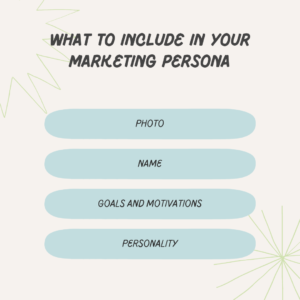
Now that we know what a marketing persona is, let’s take a look at some of the things you can include in your marketing persona to get a better idea of the people you’re hoping to convince to buy your products/services.
- Photo: It can just be a stock photo, a photo of one of your favorite clients, or it can even be a drawing if you or someone on your team has some artistic skills. The point is to humanize your marketing persona and few things do that better than a photo to help you put a face to the name. And speaking of names…
- Name: You need to name your marketing persona for the same reason you need a picture – to make it personal. The name can be the name of someone you know personally, or it can just be a name you happen to land on when opening a baby name book. How you come up with the name is up to you, but each of your marketing personas needs a name.
- Personality: Another great way to humanize your target audience is by assigning them a personality. Do your customers tend to be outgoing and attend a lot of networking events? Or are they more likely to stay home and scroll through social media? Are they readers, or do they prefer to watch videos? Or listen to podcasts? Knowing their personalities will help you identify where they hang out (both online and in the real world), which will help you get your brand in front of them.
- Goals and Motivations: What is your ideal client hoping to achieve? You can get as broad and random as you like, but it helps if you focus on the goals your product/service can help them achieve. Speaking to those goals and motivations and communicating how you can help make them a reality should be a key part of all your marketing messages.
- Demographics: Knowing things like your target audience’s gender, age range, income level, race/ethnicity, etc. can all be helpful in creating content that resonates with them. If you have clients/customers who fit into a few different demographics, consider creating a different marketing persona for each demographic you serve.
- Superior: If you’re in a B2B industry, you need to consider your target audience’s superior because they might have the final say in whether they decide to buy your product/service. You always need to consider who else is participating in the decision-making process so you can target their pain points and overcome their objections as well as those of your main client. This goes back to the story in the beginning of the toymakers making sure their commercials showed up in front of the kids who will ultimately be playing with the toys, but they also need to get approval from parents (and in-the-know aunts) because they’re the ones with the money to buy the toys.
- Pain Points: The pain point is what will ultimately convince your prospects to become customers, so you need to understand the pain point you’re solving for them, and you need to communicate that you understand their pain (and that you can solve it for them) in all your marketing materials.
- Sales Objections: We all deal with objections, even from the people who are most in need of our products/services, but we don’t need to let it go at that. We can learn to overcome those sales objections, especially if we have an idea ahead of time of what those objections are likely to be. So take some time to think about some of the sales objections you hear most often, come up with responses to those objections, and write them down so you’ll be prepared the next time you hear them.
- Background: Did your client always hold the job they have now? Did they always live in their current hometown? What brought them to where they are now, and how does that impact the likelihood they’ll decide to buy from you?
3) How to Find the Information for Your Marketing Persona
It’s easy enough to say this is the information you need to include in your marketing persona, but it’s another thing entirely to find that information. How do you know your ideal client’s demographics? Or background? Here are a couple different methods you can use:
1) Know the Problem You’re Solving

There’s a reason multiple categories on your marketing persona have to do with the problems you solve for your clients – it’s because that’s where it all begins. Don’t just know what you’re product/service does, you need to know how it benefits your customers, because that’s where you’ll find your ideal customers. Depending on the products/services you provide, those very products/services might tell you something about who your ideal customer is.
2) Identify Your Favorite Clients
If you’ve been in business for a while, you probably have some clients you prefer working with over others. It’s OK, we won’t tell your clients you have favorites.
Do your favorite clients share certain characteristics? Personality traits? Demographics? Once you know the kinds of people with whom you prefer to work, you can create content geared towards them and distribute it in the places where they’re most likely to be.
3) Check Social Media

If you just started your business and you don’t yet have any favorite clients, that’s OK, social media has your back.
Hopefully you at least know the demographics of your ideal clients because that will help you figure out which social media channels they’re most likely to prefer. If you don’t know which social media channels your target audience prefers, see where your competition is hanging out, because that will tell you where you should be. Once you know where they hang out, you can go hang out there, too, and do some information gathering.
Just like you should check out where your competition is on social media, you should also check out who they’re following and who’s following them. People your competition is following, if not your ideal clients, are at least likely to be influencers in your industry, and therefore worth following and seeing what they’re up to. Likewise, people following your competition are likely to be your ideal clients, so spend a little time digging into their profiles and seeing what else they’re posting about. What other accounts are they following? Which influencers? What books and blogs do they tend to read? What events do they attend? Where could you be showing up (both online and in person) to get in front of them?
For example, if they follow a certain blog that’s influential in your industry, see if you can write a guest post for that blog. If they’re attending certain events in your industry, see if you can get to those events. Try to become a speaker or a panelist at one of those events to put yourself in the spotlight and demonstrate your expertise.
The rest of the information you need to fill out your marketing persona is also likely to be available on social media, so while you’re digging through their profiles, see what other information you can find on them to fill out your marketing persona.
4) Conclusion
A lot of small business owners struggle to create content for their business because they’re too close to it and they can’t see the forest for the trees. Most of the time, all you need to do is take a step back and consider things from the perspective of your ideal client. Use everything we’ve covered here to help you identify and understand your target market and the rest will be easy.
If you found this content useful and would like to receive more of it, you can sign up for our newsletter in the space below to make sure you never miss an update. You can also see what we’re up to by following us on LinkedIn, Twitter, YouTube, and Facebook.
