

AI and chatbots and marketing funnels, oh my!
It’s been another rollercoaster year in marketing, so let’s talk about what happened, and what it could mean for our marketing strategies in 2026.
Table of Contents
AI Is Getting Better
Last year I wrote about how AI continues to be good for a laugh, if nothing else.
It still makes some noteworthy mistakes, but it’s making fewer of them, and some of the better chatbots, such as Perplexity and Claude, are getting better at discerning when a claim it “saw somewhere” can be backed up, and when it should be taken with a grain of salt.
That said, AI still makes plenty of mistakes, so definitely dig deeper to see where the information came from if it’s something you’re going to rely on for something important, like research for a presentation or advice about your finances or health.
More AI Overviews
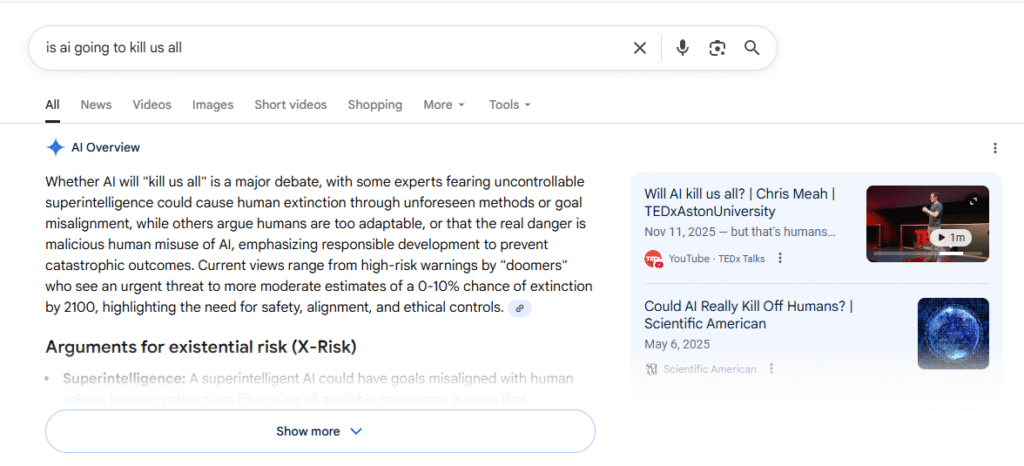
As Google has gotten more confident in the results of its AI Overviews, we’ve been seeing those overviews pop up more and more, and for a wider range of query types (i.e. people looking for a specific website vs looking to compare items/services vs just looking for information on a topic).
When AI Overviews were launched, they focused almost exclusively on informational searches, but they’ve been creeping their way into searches associated with the later stages of the buyer journey.
This has been combined with the fact that, despite the added visibility a company can get from being cited in an AI Overview, it tends to come with plummeting traffic to the website from Google, which leaves those websites without a way to capture those leads.
At the same time, Google has been playing around with the placement of its AI Overviews. Whereas they used to show up at the top of the page (and its predecessor, the Featured Snippet, was always at the top of the page), Google has started placing AI Overviews about midway down the page.
Why they chose to do this is a mystery. Their stated reason is they think it will improve the visibility of the AI Overviews, but that doesn’t make much sense given how many people don’t bother scrolling down to see what’s below the first 3-5 search results.
My guess is Google wants an excuse to save those top spots for their advertisers, who might throw a fit if fewer people are clicking on their ads because they’re not getting past the AI Overview.
More People Are Using Chatbots As Search Engines

When ChatGPT was first released and people started using it as a search engine, I had to stop myself from jumping up and down and telling people not to do that because it wasn’t built to be a search engine. It’s a chatbot, which is completely different.
You know what search engines are great at? Directing you to resources that answer the question you’re asking or selling the thing you’re looking to buy.
You know what chatbots are great at? Telling you what you want to hear.
That said, last fall OpenAI launched SearchGPT, which includes links to the resources it uses for its articles, which I love, because that’s the only way to verify the information you find, whether via search engine or chatbot.
That said, a lot of people are still using ChatGPT (not SearchGPT) as a search engine, not to mention the other chatbots, such as Claude and Perplexity, which also get used as search engines.
Now we have people announcing the death of Google and search engines and claiming the future is all about getting the chatbots to mention your brand when people ask questions about your industry.
I’m not sure getting the chatbots to mention your brand is enough, but that’s a topic for another blog post. What I will say is that Google is not dead yet.
On the one hand, yes, its dominance is slipping, but it’s not gone yet. Google used to enjoy 90+% of the online search market. Now it enjoys 80+% of the online search market.
Is that less than 90%? Yes.
Is it the same as the claim that no one uses Google anymore? Not by a long shot.
To be clear, I’m not making any predictions here. I don’t know whether Google will be able to weather this storm and come out the other end the victor, or if this is the beginning of the end.
What I’m saying is it’s way too early for anyone to know what’s going to happen.
I’m also saying that, while you should definitely keep an eye on what the chatbots are doing and how people are using them to look for information, don’t throw out your traditional SEO strategy just yet, because Google is still focusing on thought leadership, which brings me to my final point.
What’s Old Is New Again

Google’s tips for improving the search rankings of your website remain largely the same: create thoughtful, high-quality content that answers the questions your audience is asking. That’s the best way to position yourself as a thought leader in your industry, and Google loves a thought leader.
It’s also worth noting that Google has long prioritized long, in-depth content over shorter content that just skims the surface of a topic.
That’s not to say longer content is better just because it’s longer. If your blog post ends up being 700 words and covers everything you need to say, great. You’re done.
But one of the big changes the chatbots have brought to the world of online search is the ability to interact with the information we get.
Let’s say you ask a chatbot why marketing doesn’t bring in more qualified leads. A traditional search would lead you to an article — or even just a section of an article — that answers that question, and then leave you to your own devices.
When a chatbot responds with, “Messaging problems – If your value proposition isn’t clear or you’re leading with features instead of outcomes, you’ll attract curious browsers rather than serious buyers. Vague messaging attracts vague leads,” you can follow up by asking the chatbot how to fix your message.
If you have content that answers the first question AND the follow-up question(s), the chatbots will be more likely to use your content as a resource and to maybe even link to your website in its answer.
This is a lot to take in, so if you need help creating your marketing strategy for 2026, let’s talk about it.
If you found this content useful and would like to have more like it sent straight to your inbox, you can sign up for our newsletter in the space below. You can also see what we’re up to by following us on LinkedIn and YouTube.
