


You worked so hard on your website. You hired a reputable website designer and it looks fabulous. You bought the domain and prepaid for years of domain ownership. You got a great host who will make sure your site is secure and backup your data, just in case the worst should happen.
You regularly create great content for your website, including stellar landing pages, a blog full of valuable information, all of which is the right length and has relevant keywords (but is not stuffed with keywords). You regularly share your new content with your audience using your newsletter and social media.
Then you check the data on your website’s traffic and find that your bounce rate is 60% or even higher – meaning more than half of the people who come to your website end up clicking away. You might be getting more people to your website, but they aren’t sticking around.
What are you doing wrong?
Probably nothing. Depending on your industry it might be completely normal to have a bounce rate of 50% or higher. Let’s take a closer look at what, exactly, a bounce rate is, how Google Analytics measures your website’s bounce rate, and what you can do to make sure your bounce rate is as low as possible.
Table of Contents
1) What Is A Bounce Rate?
Technically, the bounce rate of a website is defined as the percentage of single-interaction visits to that site. However, Google Analytics measures bounce rate as the number of single-page visits to a website, which is a problem for a few different reasons.
First of all, there’s more to online engagement than just pageviews. There are events, ecommerce items, ecommerce transactions, social media interactions, and user-defined interactions.
Events are a great way to build engagement with your online audience, but they can also cause real problems when it comes to your bounce rate.
For example, let’s say you maintain a live chat bot on your website. The automatic invitation to engage in the live chat might count as a pageview or event according to Google Analytics. In many cases, the particular live chat application that people choose to use on their websites might cause their bounce rate to plummet because Google Analytics sees it as a second page on your website that’s been visited, regardless of whether your website visitors choose to engage in live chat, click on another page of your website, or take the next step in the buyer journey. In most cases, viewers will scan your web page for the information they need and leave once they’re done, ignoring the chatbot (which is not to say you shouldn’t use chatbots on your website, but that’s a topic for another blog post).
Cookies can also cause problems by causing sessions to reset, making the bounce rate appear lower than it is because Google Analytics thinks a user visited your website multiple times, when really they were on another site when the Google Analytics tracker caused the session to reset and fooled itself into thinking the user viewed more than one page on your website.
As Caleb Whitmore puts it, “A 3.8% bounce rate isn’t really good, it’s broken.”
2) What Is a Good Bounce Rate?
So, now that you know not to expect a bounce rate of 0%-10% the next question is: what should you expect? What is considered a good bounce rate?
There’s an overall average bounce rate that remains true throughout the internet, and then each industry has its own specific bounce rate, so rather than comparing your bounce rate to the overall average, you might find it more beneficial to compare it to your industry’s average bounce rate.

As you can see from the graph, the highest number of websites have a bounce rate around 35%, although anything from 35% to 70% is pretty normal and not necessarily cause for concern, especially if your website is new.
Obviously, if the bounce rate of your website is extremely high, something is wrong with your content, but as mentioned above, an extremely low bounce rate is also an indication that something is wrong, if not with your content, most likely with the system that measures your bounce rate.
1) Bounce Rate by Industry
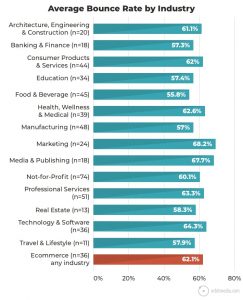
Orbit Media recently looked at the traffic data for 501 websites and broke down the bounce rate by industry, as well as source (i.e. how did people get to the website?)
Of the 501 websites they studied, the average bounce rate was 61% and the average by industry didn’t stray far from that number. The industry with the lowest bounce rate was the food and beverage industry at 55.8%, while the industry with the highest bounce rate average was the marketing industry at 68.2%. It’s not exactly a wide difference, but if you’re interested to see the exact bounce rate of your industry so you can compare your own results, you can take a look at the chart below, courtesy of Orbit Media.
2) Bounce Rate by Source
What I found to be the most interesting part of this study was the bounce rate by source. At 55.6%, organic search had the lowest bounce rate, with referral traffic having the highest bounce rate at 76.8%, although most of them hovered between 61% and 68%.

The most troubling statistic was the bounce rate for paid search traffic at a rate of 62.6%. Since paid traffic is the most expensive per visit, the relatively high bounce rate is troubling. If someone is searching for something specific and not finding it on your website after clicking on your ad, it means you need to re-evaluate either your content and/or the keywords you’re targeting because something is not working the way it should.
However, the fact that organic search traffic had the lowest bounce rate is not at all surprising, and is just further proof that a reliable SEO strategy is a better investment than advertising.
3) Bounce Rate by Keyword

When determining the source of your website’s traffic, in addition to looking at where they’re coming from, it’s equally important to look at what keywords they’re using to find your website when it comes to visits from online searches (both paid and organic search sources).
In addition to looking at the overall bounce rate of your website, you need to be looking at the keywords people are using to find your website and the bounce rate of each keyword.
While you’re at it, you should make sure all the keywords driving traffic to your website are keywords you’ve actually been targeting. You might accidentally be showing up in searches for keywords you’re not targeting, which can create problems, so make sure that isn’t an issue, and fix it if it is an issue.
Long-tail keywords tend to have a higher search intent compared to short-tail keywords. Because people are looking for something specific when using long-tail keywords, they should be easier to convert into customers, and they should also have a lower bounce rate.
3) How to Lower Your Bounce Rate
Now that we know exactly what a bounce rate is, and what to expect, let’s talk about how you can lower the bounce rate of your website. Whether your current bounce rate is higher than average, or you just think it can be better, here are some things you might want to look at when trying to lower the bounce rate of your website.
1) Your Website’s Load Speed
Your website should take no more than 2-3 seconds to finish loading. We live in an age of instant gratification, so if a website takes more than a few seconds to load, visitors are more likely to click away and try the next website on Google’s list than they are to wait patiently for the website to finish loading.
There are several factors that could be affecting your website’s load speed, including the location of your website host’s servers relative to the people trying to access your website, the number and size of videos and images, including ads, so if you’re a blogger with ads on your website and your website’s load time is exceptionally high, you might want to cut back on the ad space.
2) Take Another Look at Your Keywords
What keywords are people using to find your website? Are they keywords you were intentionally targeting, or something you hadn’t even considered? If they’re search terms you hadn’t considered, but are still relevant, then you need to add them to your list of target keywords. But if they’re not related to your content or what you offer, then you need to reevaluate your content and eliminate (or at least reduce) unrelated keywords and find ways to naturally insert your target keywords.
And again, consider the user’s intent behind the search terms they’re using. Are they just looking for information, or do they need a specific product or service? Do you have the right keywords matched to the right content on your website so that users find what they need on your site when they use your target keywords to search for something?
3) Relocate Your Call to Action
If your website visitors aren’t taking the next step in the buyer journey, the problem could be the keyword, your content, the user experience, or your call to action. One of the first things you need to look at is the location of your call to action and the type of call to action relative to the rest of the content on the page. You need to ask yourself: Is this the right call to action to go with this content? Is the location of the call to action intuitive, or would it be more effective somewhere else?
4) Make It Engaging
Not only does your content need to be engaging enough to hold your audience’s interest all the way through to the end, but you need to include images and video to break up the text and make it easy for your audience to engage with your content.
That said, remember our tip above to keep your load speed down. When it comes to images and video, it’s a careful balancing act between engagement and load speed. Not enough images and you risk boring your audience. Too many images and videos and you risk a high load speed that has people clicking away before your website even finishes loading.
5) Test 1, 2, 3

Conduct A/B testing with various keywords, images, videos, calls to action, etc. Test everything, and then test it again. Even if you think every aspect of your digital strategy is working just as it should, you never know if it could be working better until you test it.
6) Keep Track of Your Own Metrics
Keep in mind that a conversion doesn’t have to mean clicking to another page. If you have an email form at the bottom of your blog post (such as the one at the bottom of this blog post), a website visitor could fill that out and leave your website without visiting another page.
An integral part of your content marketing strategy should be considering where your target audience is in the buyer journey when they find your content. People who are using short-tail keywords are probably in the very early stages of the buyer journey, and so it doesn’t make sense to guide them to a sales page (which would reduce your bounce rate, if they were to click on the link you provide).
Instead, it might make more sense to get them to sign up for your newsletter or to follow you on social media so you can continue to engage them and put your great content in front of them until they are ready to buy.
So you should definitely keep track of your bounce rate, but also keep track of how many new subscribers and social media followers you have and where they came from. If they’re coming from your website, then don’t worry if you have a high bounce rate.
Also consider the bounce rate of various web pages. Blog posts are meant to have a high bounce rate because they are intended to provide valuable tips people can consume and then leave to implement in their own lives.
Sales pages, on the other hand, should be converting viewers into customers, so if you’re getting a lot of views on those pages, but not a lot of customers from them, then it’s time to take another look at your content (and/or your load speed) to see if you can identify the problem.
7) Ask Your Customers
Finally, you have to ask your customers if there’s anything you could be doing differently to earn their business. Have a short survey form on your website and prompt visitors to fill it our before they leave, but also take the opportunity when you’re on the phone with prospects and customers to ask them what prompted them to call you? What did they think of your website and is there anything you could be doing better?
If you found this content useful and would like to receive more of it, you can sign up for our newsletter in the space below to make sure you never miss an update. You can also see what we’re up to by following us on LinkedIn, Twitter, YouTube, Instagram, and Facebook.
In addition to creating SEO-friendly content that helps you show up in searches, our content creators excel at creating content that takes into account the user’s perspective to make sure the content speaks to their pain points so that it has a better chance of converting your leads into customers.
Reach out now if you’re ready to get started or if you have any other questions about the content strategy process.
