

I recently had the pleasure of sitting down with Jeremy Rivera on the Unscripted SEO Podcast to talk about content marketing, SEO, and how the landscape has shifted in the age of AI. We covered a lot of ground: from my somewhat accidental entry into this field to the nuances of creating content that actually connects with real humans (while still keeping the robots happy).
If you’re wondering how to create content that stands out in a world where everyone’s copying and pasting from ChatGPT, this one’s for you.
Table of Contents
- How I Accidentally Became a Content Marketer
- The Information Gain
- EEAT: It’s About How You Write
- Writing for Humans
- Lead Magnets and CTAs
- The Helpful Content Update
- It’s Still SEO
- Link Building: Still Relevant, But Evolving
- Best Practices for Content Quality
- Distribution Tips
How I Accidentally Became a Content Marketer
I’m a content marketing strategist. I know that’s kind of a mouthful and a lot of people hear that and go, “What now?”
It all started actually in college. I majored in English and psychology, which turned out to be the perfect degree for content marketing. Little did I know.
I had no idea what content marketing was. I thought I wanted to work in publishing. Had the misfortune (or fortune, depending on how you look at it) to graduate in ’09, right after the job market crashed. So there were no jobs to be had in publishing.
I answered phones for a few years, found myself between jobs at one point, and my roommate at the time, her dad, who was an attorney, was awesome and offered to give me stuff to do around his office until I got back on my feet. And one of the things he needed was someone to write blog posts for his law firm.
He knew I had a strong writing background so he offered me the gig and I was like, “What? I can get paid to write? Seriously? Yeah, sign me up.”
I jumped at that chance and started writing blog posts for him. He had been writing his own blog posts up until that point, so I was looking at his written blog posts and they started out okay. And then two or three paragraphs in, they’d switch to something completely different. I was like, “How did you get from over there to over here?”
I did eventually figure it out because I was paid to sit there and figure it out. But if I had been a prospect, I would have said, “I’m okay, I’m going to go find what I need somewhere else because this is not helping.”
I went back and said, “Yes, I can absolutely take over your blog posts for you because I know I can do better than this.”
And I did. I started out by writing two to four blog posts per month for him.
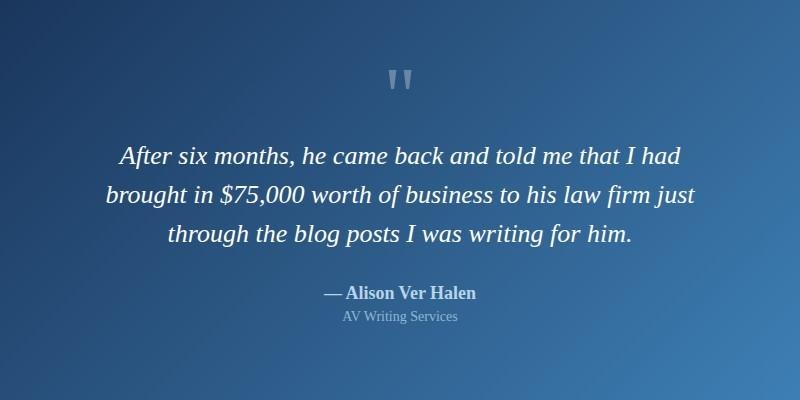
After six months, he came back and told me that I had brought in $75,000 worth of business to his law firm just through the blog posts I was writing for him.
That was my ah-ha moment as far as the idea that this is not just busy work he’s giving me as a favor to keep me busy and give me money. This is having a real impact on his business. And I love doing it.
Now I write blog posts, landing pages, sales pages, bios (all the long-form website content) for a variety of professional service firms.
The Information Gain
Jeremy Rivera: I’m curious, what’s some of your methodology for researching and developing that content? I’ve had a lot of conversations with Matt Brooks of SEOteric about how we get the sources of our content.
And unfortunately, the shorthand for many businesses since the ChatGPT craze has just been to type in a prompt and then copy and paste. You and I probably have very similar perspectives on that, but I’d love to get your opinion on the concept of information gain, which is: what is unique in the content that you’re producing versus just the basic fundamentals.
So what’s some of your methodology? What’s some of the groundwork and back-page work you do? What do you scribble on the envelope before you open up your writing tool, whatever it might be, and start typing away?
Alison Ver Halen: It depends on the client that I’m working with. If it’s been someone I’ve been working with for a long time, or in an industry I’ve been working with for a long time, I have that baseline knowledge. Sometimes I might want to go out and search the internet.
My favorite for searching is still Google. I use ChatGPT for other stuff. I don’t trust it to give me accurate information. So I go out to Google to look for information. And as you said, it’s all about information gain.
At some point, I always have to go back to my client and ask for their perspective on this:
- Why are we covering this?
- Why are we covering this over this?
- What are the misconceptions around this topic that other people might find on ChatGPT or on other sites that they’re not going to find here?
Because yes, it is all about your unique perspective, your unique experience. That is what is going to help you stand out from the crowd among all the people who are using ChatGPT the wrong way and just having it regurgitate a bunch of information for them and they slap it on their website without any editing, much less fact checking.
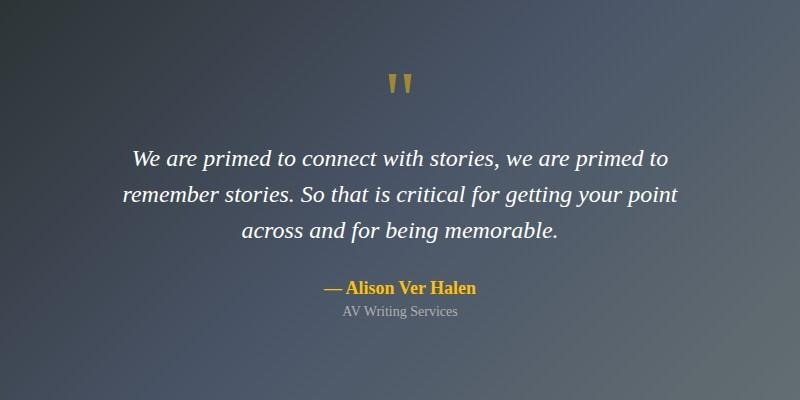
So, yes, definitely make sure you have your unique perspective and experience. If you can wrap it up in a story, we are primed to connect with stories, we are primed to remember stories. That is critical for getting your point across and for being memorable.
So wrap it in a story. And if you can wrap it in a specific example that you have dealt with in your career, all the better, because again, that’s gonna stick with you and that’s what’s gonna set you apart from the millions of other people who are like, “Well, here are the three reasons you need X, Y, Z, and here’s the call to action, the end.”
E-E-A-T: It’s About How You Write
Jeremy Rivera: It strikes me that you’re saying E-E-A-T without saying the acronym E-E-A-T.
Alison Ver Halen: Mm-hmm. Yes. For those of you not in the know, E-E-A-T is Expertise, Experience, Authority, and Trustworthiness, which is something Google updated into their algorithm years ago and have since been updating.
Jeremy Rivera: My friend Michael McDougald of Right Thing Agency posits a theory that actually E-E-A-T is largely reflected in how you write your content and couching your insights from a first-person perspective.
Citing, “Hey, when we completed this project in 2007 of installing a sunroom in Mrs. McGuire’s house at Cookeville Sunrooms, here’s what we learned about overages on material cost projections that we fixed for our business and now we can provide better building services for our clients.”
Alison Ver Halen: First of all, yes, the author profile is part of it. There was an initial E-A-T, which was just the expertise, authority, trustworthiness, which Google launched in 2014, and at that point in time, having the author profile would do it.
But Google has gotten smarter and smarter as to what makes good content that’s actually trustworthy and answers people’s questions.
After a while, not only did they figure out that the experience part—that extra E—is an important part, they also figured out how to measure it. And that’s where E-A-T became E-E-A-T.
My approach to SEO has always been: write the content that answers the questions your people are asking.
Keep doing that, do it consistently, do it every day, every week, every month, and keep doing it. And Google will eventually figure out what you’re doing. And if you’re really good at targeting your audience, they will figure out who your ideal client is, and they will help those people find you as they ask those questions of Google.
There is always this kind of fight between technical SEO and the writers who want to write for the humans. Yes, sometimes it’s a fine line you have to walk, because we do have to make the robots happy. But at the end of the day, you have to actually engage and convert the real live humans who are finding your website.
So keep writing quality content and the robots will figure it out.
Writing for Humans
Jeremy Rivera: I think it’s an interesting challenge because you have a robot sandwich happening quite frequently now and I think it’s going to keep happening more and more often.
The searcher is using ChatGPT, but AI doesn’t have a good knowledge base, and if they don’t have that training-based knowledge for your query, they’re going to do a live search of search results.
So it’s a robot asking a robot what humans have written for humans based off of what they think that humans want to see. Or rather, humans have trained robots to think what humans want, to give answers to robots thinking about what humans want.
Alison Ver Halen: It’s like looking in a mirror where there’s a mirror behind you and you have all of those reflections.
Jeremy Rivera: For whom am I creating this content? And I think functionally, there isn’t a lot of reason in the writing style or in what you’re putting down in words to not mostly focus on or mostly highlight things that are great for user experience anyways—that are AKA for humans—but they are also well digested by bots.
For example, having a great internal link strategy. If you are going through and writing your content, then part of your workflow should be supporting the concept by citing external sources, including quotes, which then means attributing them properly, which means linking out. And then finding things and resources internally that can enrich their journey or send them further down in your conversion funnel.
This means you need to know what other content you have on your site or have great tools that can do that. One of the biggest failures I often see in content is a lack of links, which is funny because there was like this editorial standard where newspapers specifically avoided adding any sort of links at all to their content.
They were afraid of pissing off Google and there was this weird fear of placing links in content on news articles, which was always a frustrating experience because they’d have a 20-page in-depth interview with the founder of this company and never actually linked to his website.
So it was a terrible user experience, but it became the norm in news writing. I find being more aware of the details of your company can often lead to you creating more structurally sound content because you’re not assuming the journey of that content is going to end with that one article. You’re providing them bridges deeper into the site—thinking about the whole conversion process versus just, “I’ve got a plate of food, come and eat it and leave.”
Alison Ver Halen: You have to think about the buyer journey, which means first, Where are they in the buyer journey when they encounter you?
I work with a lot of professional service providers who have a long buyer journey, which means it’s a higher investment. There’s usually more than one person involved in the buying decision, which means they’re not going to read one blog post or one social media post and be ready to buy.
They’re going to want to read more blog posts. They might want to sign up for your webinar, subscribe to your newsletter, follow you on social media for a while, go back and talk to their partner, their spouse, whomever, and then come back and then they call you.
So the job of that content is to lead them through that funnel because if you just have them read one piece and then you ask for—you know—a discovery call, which we all know means sales call, or a consultation, you know, same thing.
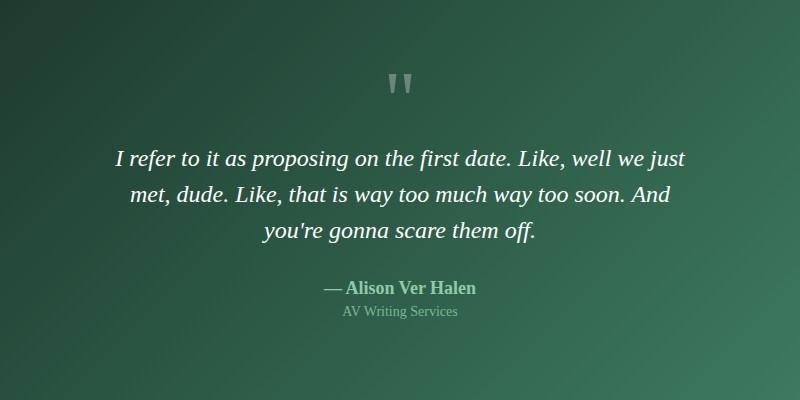
I refer to it as proposing on the first date. Like, “We just met, dude. That is way too much, way too soon.” And you’re gonna scare them off and they’re gonna run away and forget all about you and they’ll never come back.
So yes, you need a way to capture that lead, but in a way that makes sense for where they are in the buyer journey and leads them naturally to that next step.
That next piece of content also has to provide more value, provide more information they can actually use, educate them, position you as a thought leader in your industry, as the go-to person in your industry, while then again leading them to the next stage of the buyer journey until they are ready to buy. And that’s when they reach out to you.
Lead Magnets and CTAs

Jeremy Rivera: What type of secondary calls to action or deliverables or downloadables have you experimented with alongside those?
For example, at the top of the funnel, rather than proposing on the first date, you might say, “Hey, let’s go get some coffee over this PDF of how to save costs in your commercial kitchen.”
What’s been your experience in developing those additional assets, resources, best practice on conversion or CTA forms?
Alison Ver Halen: Before ChatGPT, checklists were a quick and easy way to capture those leads. “Hey, do you want the checklist?”
Now everyone can get a checklist from ChatGPT. That doesn’t have the value it used to have.
Ebooks are super popular. Short ebooks, sometimes only a few pages, up to a full-length ebook if you’re willing to give that away for free as a lead magnet to give away a lot of information.
It’s all about understanding your ideal client and where they are in the buyer journey. I tend to really emphasize making it as quick and easy as possible to get your download. Email address, name, that’s it. Give me the thing. Don’t make it super long and complicated.
But I have signed up to get lead magnets where they do have me fill out a page’s worth of information, and I’ll do it if I really want that information. That’s when you tend to get like, “We did this whole study and we found all this information and this is the latest analysis on such and such.” That’s something for which I’m willing to give more information and spend a little more time to get.
And on their end, it works as kind of a gatekeeping system, right? “We only want these leads who are serious about buying our stuff. If they’re not interested in what we’re providing enough to fill this out, they’re not an ideal client.”
That’s how you can engineer a bit of self-selecting based on the kind of lead magnet you’re providing and how you have people download it.
The Helpful Content Update
Jeremy Rivera: What’s your understanding of the Helpful Content Update and possibly understanding what it is as far as a backlog of content or a type of content that seems to be penalized heavier?
Or do you follow the Hobo SEO rubric that the HCU is just a diagnosis of a lack of brand identity and Google not understanding or really giving you credit for being a credible organization? And that’s based in part off of the actual content, but also based in part off of a lack of signals of actual users coming to your site?
Coming to the conclusion that you’re really just an SEO that’s discovered, “Hey, I can programmatically put 50,000 entries of celebrity birthdays. You don’t really have a good business model, you’re just trying to rank and get traffic and turn that into money.”
So what’s your thoughts on HCU—one of those two, or maybe something different?
Alison Ver Halen: I did hear someone talking about it not too long after the HCU was released, and they were pointing out the fact that that was really the only time Google really ever said “this is the update.”
Normally they give it a really weird name like Panda or something. And now it’s just the month and the year that it starts to roll out. They’ve stopped giving them names at all.
The Helpful Content Update was the only time that they gave the update a title that actually described what they were doing.
That leads me to think it might have all been a hoax. Looking at the changes in traffic during and immediately after that update revealed much less volatility in website traffic than we normally see in major updates to the algorithm.
That said, Google is constantly identifying what makes good content. The robots are learning. They know when to say, “We’ve seen this before.” “We’ve seen this a million other places,” which is why using ChatGPT to “create” content isn’t effective. I put “create” in quotes, because AI does not generate anything. It just regurgitates what humans have already created. The people who are just using ChatGPT or their LLM of choice and copying and pasting are not going to get the results they need because AI is going to be like, “Yeah, we saw this everywhere.” And again, the real-life humans are going to be like, “Yeah, we saw this everywhere.”
So broadly, yes, I do think Google is identifying what makes good content:
- Is it easy to read?
- Do people stick around or are they bouncing away?
- Is it unique? Is it saying something different?
- Does it have a unique perspective?
The point about brand identity is interesting. I would not be surprised if that’s the case because it’s cumulative. It’s not just Google looking at one blog post that you wrote and going, “Okay, this is great, we’re going to rank it.”
It’s considering, how does this blog post fit in with the other blog posts? How does this blog post fit in with the website as a whole?
And, yes, if you start writing stuff that has nothing to do with your business and you’re just shoving links in there, it’s going to look pretty spammy.
It’s Still SEO
Jeremy Rivera: I think it kind of plays into one of the trends I’ve been seeing. The blessing of this conversation over, I’d say the last six months of “No, SEO is dead again,” has been “Well, it’s GEO. No, it’s AIEO, and what does that mean?”
“Well, actually getting your site mentioned, getting your brand mentioned, getting an article about your business on some other websites that is then cited in LLM results.”
Pretending SEO isn’t SEO so it can be called something else is just a unique game that we do every couple of years.
But again, we face a situation where we’re creating content and finding ways for that conversation.
The whole obsession over domain authority and all that nonsense, I think starts to take a back seat when it’s more about, “Hey, these are the sources that LLMs themselves are saying they are considering,” and they’re not considering a PBN site that has your article about skincare, and then next article is about a dumpster team in Atlanta.
Obviously it’s all paid. The LLMs aren’t citing those as sources. Instead, they’re citing local newspapers, citing SaaS companies that have published listicles. That’s a huge thing right now in citations.
When it comes to content marketing, obviously it’s not just writing content, there’s also the marketing side of things. So what’s been some of the strategy or processes of getting mentions, getting into the marketplace, getting links? It does still have a place in digital marketing.
Alison Ver Halen: First I want to get on my soapbox a little and talk about how much I hate the whole GEO, AIEO, blah-de-blah-de-blah. It’s still SEO, people. Just because the search engine has changed does not mean that it’s not SEO.
I think it’s so funny that we’ve all come to think of SEO equals Google, to the point where now that the SEO part is not necessarily Google, it’s like it needs a different name, when that’s not the case.
The one I’ve heard was AEO for Answer Engine Optimization, which I do like because that does talk about how it’s different from SEO. You’re not looking for a database. You’re not looking for a list of links. You’re looking for an answer.
And that’s really what people are looking for when they go to ChatGPT or Claude or whatever your favorite LLM is: they’re asking a question, they’re looking for an answer.
I don’t know how valuable it is, especially since we’re talking about the top of the funnel, which tends to involve a lot of informational queries.. Those are the questions like, “What is this industry? What do I need to know about this? Do I really need XYZ?” When people are just looking for information they’re going increasingly to their LLM to get an answer and then go, “Great, thanks ChatGPT,” and they go on with their day.
I don’t see a whole lot of value in getting mentioned there. So when people talk about like, “Let’s get mentioned in the LLMs,” you first need to ask: what do you want to get mentioned for? How do you want to get mentioned? When do you want to get mentioned? What are the questions people are asking that will have the biggest impact if you can get mentioned there? You need to answer those questions before you start worrying about getting the chatbots to mention you.
Link Building: Still Relevant, but Evolving

Alison Ver Halen: You mentioned link building, and you also mentioned earlier the newspapers not wanting to include links for fear of pissing off Google. It’s all kind of connected because link building up until very recently has been a big part of SEO.
And for those who are listening who are unaware as to what we’re talking about, link building is when you get another website to link in their content to something on your website.
For example, if I have a blog post and I’m saying, “Hey, Jeremy Rivera is talking about this really cool thing, go check this out over there on his website,” and I include that link, that would be me building links for him.
Google likes to see people playing nice with each other. If someone else is using you as a reference that shows that you are an authority. People are using you as a reference. You must know what you’re talking about.
But Google also assumes like hangs out with like. So the higher quality people linking to your website helps your website. The lower quality websites linking to your website can actually hurt your ranking.
And that’s link building in a nutshell.
Going back to the earlier point about newspapers not wanting to links: Google, for some reason, decided it did not like guest blogging as a way to build links, which was the main way people built links for a long time.
Go out and guest blog. I could write a blog for your website. You could write a blog for my website. We would link to each other’s websites. Now you have a new link and exposure to a whole new audience or part of a new audience. You’re expanding your reach, expanding your authority.
That was (I think it still is) super powerful.
For whatever reason, Google decided it doesn’t like that, so it requested all of those links be tagged as no-follow, which means it doesn’t do anything for your SEO. Google’s not going to count it towards your search rankings.
It makes no sense because, if people are featuring you on their website, if they’re saying, “Hey, you know, Jeremy has something cool to say, go check him out,” that’s your authority.
But when Google decided it didn’t want those links to count towards SEO some people overcorrected and refused to add links at all when having a guest author on their blog because they were afraid of incurring Google’s wrath.
I don’t think Google has entirely gotten away from links. I don’t think it weighs as heavily in favor of your SEO as it used to.
I always like to say Google knows all, which means if someone is mentioning your website, your name or your brand over on their website, even if they don’t provide a link, Google’s going to go, “Well, there’s only one AV Writing Services. There’s only one Alison Ver Halen who spells her name this way.”
It’s really good at figuring out when other people are talking about you. So just having them mention you can be beneficial for your search rankings.
And I still like guest blogging and getting that earned media just for visibility, because that’s going to be the best way to get in front of new people, especially in a way that already has a little bit of that KLT Factor, (Know, Like, Trust.
If people are following me, they know and trust me, and I say, “Hey, listen to Jeremy, he really knows what he’s talking about on the subject, take it away Jeremy,” they’re going to be like, “Well, Jeremy must know his stuff about because Alison said so and she’s the best.” There’s a lot of goodwill already built into that.
There are other ways around it, but I still love podcasting, guesting on podcasts, guest blogging, guest newsletters. Do all of the guesting and get as much earned media as you can, because that’s a great way for all of the things—for your SEO, for getting in front of new audiences, and just building that network, building that audience.
Best Practices for Content Quality
Jeremy Rivera: So as we kind of wind down here, what are some of the best practices you’ve adopted with your clients to gain that visibility or exploit the quality angle of the content you’re creating? What are some of those low-hanging fruit items that you always knock off your list for new clients when they’re coming on board?
Alison Ver Halen: For quality, like I said, it’s getting their unique perspective on a topic. What do you think about this?
Always making sure I know their voice so it sounds like it came from them instead of sounding like it came from me or ChatGPT. Again, that’s for the real-live humans who are like, “Wait, this doesn’t sound like Suzy. Where did this come from?” And then they think it’s ChatGPT and then they don’t like it and that becomes the whole thing.
Even the robots are gonna be like, “This sounds different.” It’s gonna clue them in that it’s unique content. It’s gonna be part of that piece.
Making it as clear and easy to read as possible is also super important. I try to avoid big words whenever I can just to make it easier for people to read and to get through.
Make it skimmable. Yes, people will skim your content. I know it’s painful to hear that after you spend hours creating and polishing and editing and posting that content, but it’s the harsh truth.
So make it really easy for them to skim. Include those subheadings so they can skip to the part that is most relevant to them and get that juicy information.
Lots of white space also makes it easy to read and people will find themselves continuing to read without realizing that’s what they’re doing because they have to keep scrolling every few seconds and they just scroll to the next line and then the next and then the next and before they know it they’ve read the whole thing.
Distribution Tips
Alison Ver Halen: As far as distribution, social media is my favorite for distribution. Also repurposing.
For example, you could have a podcast like this with a video element and put the video on YouTube and put the audio up on the podcast channels and then transcribe it and have to clean up the transcription and put that up on your website as a blog. Now you’ve got three different pieces of content.
You’re saying the same thing in all the different places, but people who want to watch the video can watch the video. People who want to just listen on their car ride or their commute can do that. And people who actually want to read it can read it.
Before we started recording, you talked about breaking it up into clips. Absolutely do that. Break it up into clips, break it up into shorts. People love those clips. People love the shorts. If it’s a nice, juicy short and they go, “Yes, I want to learn more about this,” then it’s a great lead-in to get them to read or listen to or watch the larger piece of content.
Another trick I found on social media is mentioning people, but I don’t mean those posts where you mention 10 people because that feels spammy. But if it’s like, “Hey, I’m so glad to be on Jeremy Rivera’s podcast, thanks so much for having me,” by tagging them that’s gonna:
A) Notify them. The platform will notify them, “Hey, you were mentioned over here.” They’re gonna sit up and pay attention. They’re probably gonna share it with their audience. That expands your reach.
And always, always share your newsletter. Let your people (who are already following you) know where you’re hanging out and what you’re doing. Because they can be your biggest supporters.
And just ask for the share. That’s a great way to get in front of other people’s audiences. It’s just, “I did this thing. I was on this thing. Please share it with anyone you think would appreciate it, would get value out of it.”
And you’d be surprised what you can get just by asking.
If you found this content useful and would like to have more like it sent straight to your inbox, you can sign up for our newsletter in the space below. You can also see what we’re up to by following us on LinkedIn and YouTube.
