
Last week I spent 3 days (actually it was closer to 2.5 days) in Seattle for the Seattle Interactive Conference. It was two days of a bunch of tech geeks coming together and geeking out over tech and marketing.
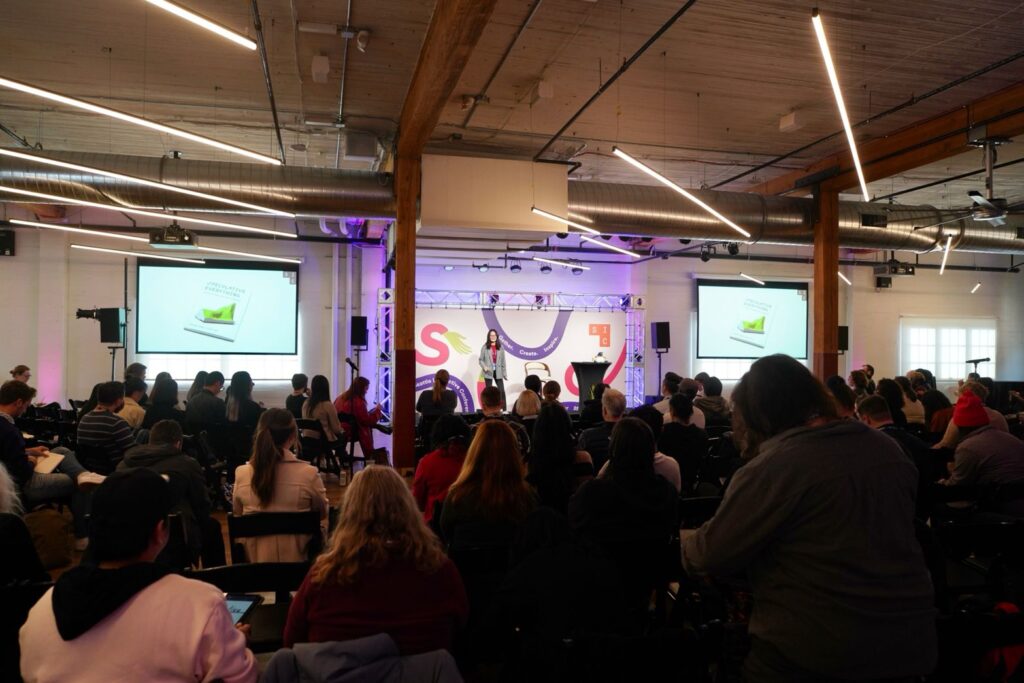
I gave a presentation about the importance of storytelling in marketing, but since I wasn’t able to take a photo of myself, the photo above is of Elena Cai, who gave an awesome presentation about speculative design and crafting the future you want instead of dreading a future you don’t want. It was so inspiring and definitely gave me a different perspective with which to think about the future.
I wish I could have made it to every presentation, but since they had two presentations going at once and I have not yet learned how to be in two different places at once, I could only attend about half of them. Here are some of my favorites.
Table of Contents
- How Much Time Do You Spend on Your Headlines?
- Google Is Messing with Us
- Think Outside the Box for Your Next Marketing Campaign
- Let’s Talk About the Elephant in the Room: AI
- The Real Conference Was the Friends We Made Along the Way
How Much Time Do You Spend on Your Headlines?
Brianne Dromey of One Net Inc. gave an awesome presentation about how to create the perfect headline. She gave tips for coming up with 50 unique headlines for every headline you create. She was insistent, that, yes, you really have to create 50 different headlines for every, single headline you write, but she took us through the process and introduced us to some handy tools to show how we can come up with 50 headlines in a reasonable amount of time.
The key is to put away your inner critic and write down every, single idea you have, no matter how bad or silly it might seem, because you never know what could end up being the most useful. She said between 30-50 is where the magic happens and you get some really good headlines, which is why she was so adamant about going through this process with every, single, headline.
That said, when asked about it during the Q&A portion, she admitted that if you’re pressed for time and it comes down to writing 50 headlines or making your deadline, you can still get a decent headline if you come up with 30 iterations. She also admitted to not spending as much time on some of the subheadings she writes. But if you’re trying to come up with a headline for a really important landing page for your website, or a tagline for your business, don’t skimp on the process.
The tools she mentioned are Power Thesaurus, Phrase Thesaurus, and Word Hippo.
She also pointed out that each headline can have one of these elements as its focus: attitude, differentiation, benefits, or features.
The four steps she went through to get to 50 headlines include imitating the voice of the customer (after gathering data to learn which words they use to describe your product/service), word play, picture play, and table mergers (merging the words you come up with from the four different elements listed in the paragraph above).
Google Is Messing with Us
Another great presentation was by Kavi Kardos, director of SEO for the Corporate Finance Institute. Her presentation was all about crafting content and websites for humans, rather than focusing on what Google wants (or what Google says it wants).
Kardos and I are totally on the same page when it comes to the idea that the point of ranking on the first page of Google is so you can convert the people who find your website into customers, and if your website is optimized for Google rather than humans, you’ll lose those prospects. Google is a means to an end, not the end game itself.
She also brought up some very good points about Google’s Helpful Content Update: They gave us a big heads up that it was coming (which they notoriously never do), they gave it a very descriptive name (which is also unusual), and at the end of it all, nothing much happened. Her conclusion was that it was nothing more than a massive PR stunt. Google wants us to believe that it prioritizes helpful content, so it made it look like it was working towards that goal, even though there’s no evidence that it was working towards that goal.
Good PR = SEO
She also gave some data on a Texas grocery store (she lives in Texas) that gave away free groceries during the height of the pandemic. Prominent news outlets wrote about it with the result was that the grocery store’s organic online traffic rose exponentially. Kardos described it as an SEO strategy disguised as a PR campaign, and I loved that idea because there’s no reason PR and SEO can’t work hand in hand.
As a funny side note, it turns out Kardos and I took almost identical paths into the world of SEO and content marketing. We both wanted to go into publishing (she actually majored in publishing), and we both graduated in 2009 right after the job market crashed and there were no jobs to be had in publishing, so we both ended up in digital marketing!
Think Outside the Box for Your Next Marketing Campaign
Rebecca Coleman of The Narrative Group gave an awesome presentation all about how thinking outside the box when it comes to your marketing campaigns can really pay off. She gave examples of some major campaigns she worked on for huge brands like McDonald’s and Illumination, and her stories were so inspiring.
She does a lot of social media and influencer marketing, which is not at all what I do. What I ended up taking away from her presentation was the common thread she had of listening to what customers really wanted and finding a way to reflect that in the marketing and advertising they did for their clients. I especially loved one example she gave in which she said they dug deep into the different subcultures of a particular fanbase and created content aimed at each of those subcultures. It was so strategic and on point and it paid off in a big way.
The other thing I took away from her presentation was how taking a risk in your marketing efforts can pay off. The campaign she did for McDonald’s was something they had been trying to pitch for two years, but McDonald’s wouldn’t go for it until the pandemic hit and they were suddenly desperate to get people to their restaurants. When they finally did give it the greenlight, they made back their investment on the marketing campaign three times over.
Let’s Talk About the Elephant in the Room: AI
This is a tech conference, so of course there were going to be presentations on AI. There was one about creativity in AI that I didn’t get to see because it was at the same time as my presentation. The presentations I did see about AI did nothing to impress me. The men giving them had clearly not prepared before getting up on stage and did not seem to have any idea as to which point they wanted to hit on after covering their last point. One of them even said, “Is this even interesting? I don’t know.” in the middle of his presentation. I felt like these men didn’t even know where they were, much less what they were doing.
By contrast, all the presentations I saw given by women were very organized, well thought out, and kept me engaged the whole time they were on stage. I don’t know why that is, I just know I attended some presentations that were not worth my time.
The Real Conference Was the Friends We Made Along the Way
To end on a high note, I just want to say that I had a blast at this conference, not just learning about digital marketing, but getting to know some of my fellow speakers, many of whom were so impressive!
Below is a picture of a handful of us. From left to right is Moses, one of the organizers who made sure we kept it together as we were preparing to go onstage; Elena Cai, who’s presentation is pictured at the top of this post; Dominique Luster, who gave an excellent presentation on the storytelling strategies of history (and how to not lose them in the digital age); Luis Antezana, who talked about Web3 and cryptocurrency; myself; Jess Vice, whose presentation on design and accessibility I missed in favor of Rebecca Coleman’s presentation; and Brianne Dromey.

Want to ask me something specific about the conference? Or just hang out? Just reach out to get the conversation started.
You can also see what I’m up to on any given day by following me on LinkedIn, YouTube, Twitter, or Facebook. If you want to get weekly updates from this site, you can sign up for our newsletter here:
