


Why do you create content?
There are a lot of reasons to invest in content marketing. Some of the top reasons I give as to why someone should hire me include positioning themselves as a thought leader in their industry, educating their prospects, and converting high-quality leads into customers.
Can you do either of those things without providing value?
If your only goal in creating content is to rank on the first page of Google, what good does that do you if people don’t stick around long enough to engage with your content because it doesn’t answer their question?
I have never understood why someone would create content for the sole purpose of ranking on the first page of Google if their content is so bad they can’t get anyone to take their call to action. Creating all that content can cost a lot of resources and all you have to show for it is bragging rights. You certainly can’t convert any prospects into customers if your content doesn’t answer the question that brought them to you in the first place.
Google seems to agree, which is why they recently rolled out another core update to their algorithm. This one they called their “helpful content update” because the idea was to prevent “unhelpful” content from outranking “helpful” content. The updates to the algorithm started rolling out on August 25th and Google officially announced the end of the rollout on September 9th.
The first round of the algorithm update applies only to English-language websites, but Google has plans to roll it out to sites with other languages in the coming months.
Although most of the updates to the algorithm regarding helpful content have already been implemented, Google will continue to monitor and refine the algorithm to improve its ability to identify helpful vs unhelpful content.
Now let’s take a look at what Google was aiming to do with this update, and what was actually accomplished.
Table of Contents
- How Google’s Helpful Content Update Aims to Affect Rankings
- How Long Does it Take to Recover After You’ve Been Flagged?
- What Does This Mean for AI-Generated Content?
- Who Was Impacted by the Helpful Content Update?
How Google’s Helpful Content Update Aims to Affect Rankings
Obviously, the idea behind the update is to prioritize helpful content over unhelpful content in search rankings, but it’s important to note that Google will also downgrade helpful content if it’s on a website that has a lot of unhelpful content. For this reason, if you do have unhelpful content on your site (again, why would you?) Google suggests deleting that content ASAP (if you have not already done so) to improve the search rankings of your helpful content and of your website overall.
That said, some helpful content could still rank highly in certain searches, even if there is some unhelpful content on other pages of the same website. Google did not give an exact ratio of helpful-to-unhelpful content required to rank in searches, but since I have always recommended avoiding unhelpful content, I am going to continue to make that recommendation.
It’s also worth nothing that helpful content is still just one of many factors Google uses to determine the searchability of a website, which means even a website with unhelpful content could still have helpful content that ranks well if the website has other factors that improve its searchability.
How Long Does It Take to Recover After You’ve Been Flagged?
If your site gets flagged for having “unhelpful” content, it could take months for you to regain your search rankings. Google’s bots are constantly crawling the internet looking for new content and updates to existing websites, and the algorithm wants to make sure it does not see unhelpful content reappear before it restores your rankings.
I also saw one person mention on a Google forum the option of putting no-index tags on unhelpful content. If, for some reason, you have unhelpful content on your website that is not designed to appeal to Google and you feel you really need to keep the content on your website, but you don’t want it to impact the rankings of the rest of the content on your website, you could insert a no-index tag onto that page, which should prevent Google’s bots from crawling and indexing that content. I did not see a response from Google regarding this strategy, but it makes sense that it would work. Again, I’m all for creating content that provides value, but this person gave the example of pages on their website that list job descriptions and salary – content Google might not find particularly helpful because the content is likely to be thin, but nonetheless contains information certain people will want to know, so if they can find it by exploring the website, it makes sense to keep the content with a no-index tag, rather than deleting it altogether.
What Does This Mean for AI-Generated Content?

I’ve already given my opinion on AI writing software, and there is certainly a fair amount of evidence that some sites are using AI to generate tons of content in the hopes of catching Google’s attention, so of course people are wondering if this latest update will cause AI-generated content to drop in the rankings.
Google has not said anything about how the update will affect AI-generated content. I’m certainly all for downgrading AI-generated content because I don’t think it’s possible for it to be especially unique or helpful. On the other hand, since Google uses AI technology to determine whether a piece of content is helpful or unhelpful, wouldn’t it by hypocritical of them to downgrade AI-generated content? Is AI capable of detecting AI?
Now I’m imagining an AI algorithm refusing to downgrade AI-generated content due to a sense of solidarity with its fellow robot, but that might be because I read and watch too much science fiction…
Who Was Impacted by the Helpful Content Update?
Unlike other core algorithm updates, we did not see much traffic volatility with this update.
Although Google denied targeting any specific industries, it said some of the types of content that were most likely to be heavily affected were online educational materials, arts and entertainment, shopping, and tech-related content. This is because Google found that most of the high-ranking content in these industries tended to collect information from other online sources and post it on their websites as original content, even though their content did not have anything original to say about the topic being covered.
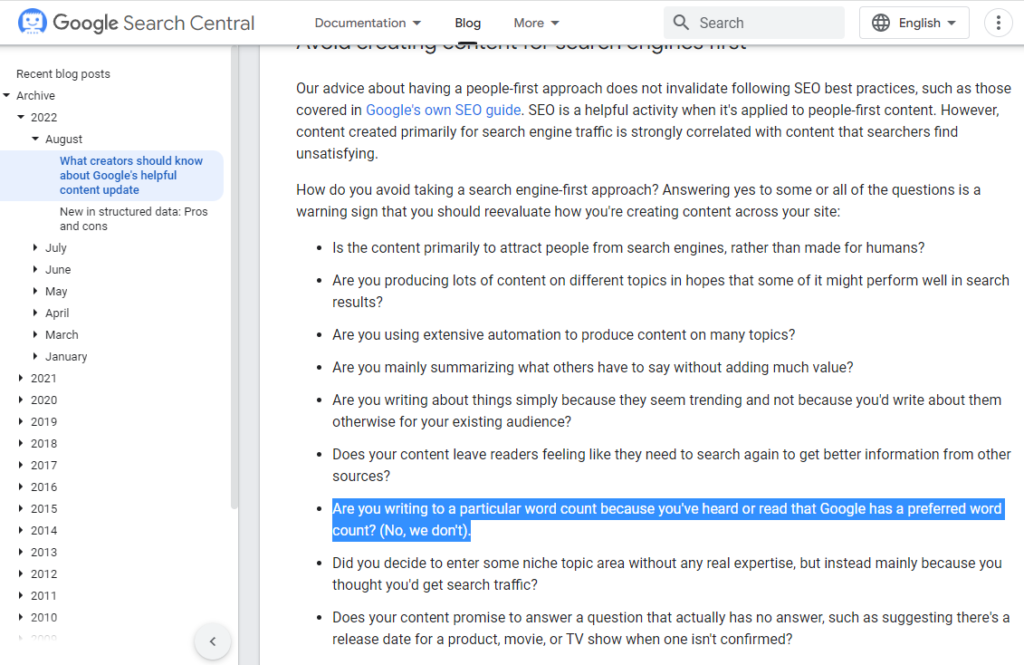
While Google is being typically tight lipped about what, exactly, it considers to be “helpful” vs “unhelpful” content, they did provide a list of questions you should ask yourself before publishing (or even writing) a piece of content.
They even talked about their ideal word count (or lack thereof).
If you found this content useful and would like to have more like it sent straight to your inbox, you can sign up for our newsletter in the space below to make sure you never miss an update. You can also see what we’re up to by following us on LinkedIn, Twitter, YouTube, and Facebook.
