

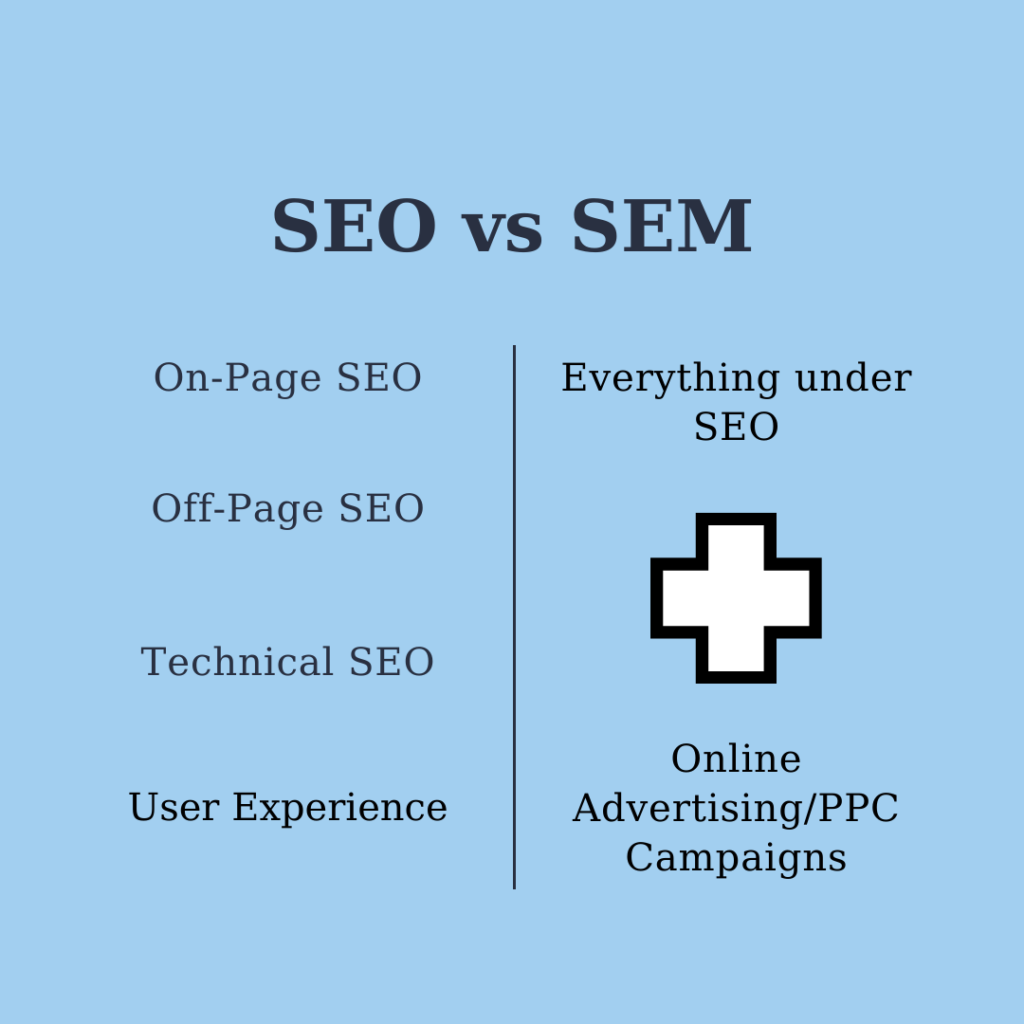
I tend to see the terms SEO and SEM used interchangeably, and while they can be used interchangeably up to a point, it’s worth pointing out their differences, as well as their similarities so we all have a clear understanding of what we’re talking about when we say SEO vs SEM.
Table of Contents
- What Is SEO?
- What Is SEM?
- What Does SEO Include?
- What Does SEM Include?
- The Biggest Difference Between SEO vs SEM
What Is SEO?
SEO stands for “search engine optimization,” so while we’re on the topic, I would really like to see people stop saying things like “SEO optimization.” It’s as annoying as “ATM machine.”
Optimizing a website for search engines means you’re following Google’s best practices to try to get the search engine to like your website and the content on your website so you can rank organically for relevant keywords.
What Is SEM?
SEM stands for “search engine marketing” and it includes trying to get your website to rank organically as well as using paid advertising to get your website on the first page of Google, even if you don’t organically rank for those keywords.
Essentially, SEO is entirely organic rankings, whereas SEM is a mix of both organic and paid rankings. As a result, you can think of SEO as fitting under the SEM umbrella.
Now that we have a broad idea of SEO vs SEM, let’s take a closer look at what each one includes.
What Does SEO Include?

Google analyzes hundreds of factors to determine where to rank your content for certain searches, and it’s constantly adjusting the algorithm to try to perfect the process. Nevertheless, SEO can be broken down into four main categories: on-page SEO, off-page SEO, technical SEO, and user experience.
On-Page SEO
I just wrote a whole post on on-page SEO vs off-page SEO, so I don’t want to get too deep into it here, but I can cover the basics. Essentially, on-page SEO is everything on your website that determines your ranking position. This includes keywords, meta tags, content marketing, internal backlinks, etc.
Off-Page SEO
Off-page SEO is what other people are saying about you on their websites that affect your SEO. This includes external backlinks, but even a mention of your brand without a link is enough to let Google know someone is talking about you. Social media also falls under off-page SEO as it can be used to raise brand awareness and drive organic traffic to your website (and the more organic traffic Google sees going to your website from other links, the more likely it is to assume your content has value and raise your search ranking position accordingly).
Technical SEO
I try not to get too technical when I talk about SEO because I want to keep my content accessible for the people who aren’t as familiar with that side of SEO, but it’s nonetheless an important factor in your search rankings. Things like your page load speed, making sure Google can index and categorize all your content (or the content you want categorized), making sure there’s no repeat content or keyword cannibalization happening on your website, all fall under the umbrella of technical SEO.
User Experience
Google wants to give its users a good experience, and if they bounce back from your website, that indicates a poor user experience. Admittedly, a certain percentage of visitors are bound to bounce from your site for one reason or another, but if the percentage gets too high, Google will assume your content is not relevant to the search term, the content is low quality, or the website provides a poor user experience. Google will respond by downgrading your ranking position for that keyword.
Things like page load speed affect your user experience, but you also have to make sure ads or images don’t shift the content while your user is trying to interact with your content.
What Does SEM Include?
SEM includes everything discussed above, plus paid search advertising, also known as PPC (pay per click). If you’re not familiar with PPC advertising, it’s called that because instead of paying to maintain your ranking for a certain period of time or the number of views, you only pay when someone clicks through to your website. Hopefully the copy on your website is compelling enough to convert enough visitors to make the costs of advertising worthwhile.
Bidding System: There is no flat rate for PPC advertising. Instead, it’s a bidding system, meaning you place a bid on a keyword and Google places your ad based on what other people have bid for that keyword. For example, if you bid $5 to rank for a keyword, another website bid $3 and a third website bid $1.50, your ad would be at the top of the first page of Google with the second website below it and the third website at the bottom, just above the organic rankings.
Quality Score: Just like Google has a system for determining how relevant and effective your content is when ranking organically for certain searches, it also has ways of determining how relevant and effective your content is when you’re paying to rank for certain searches. It looks at things like your click-through rate (CTR), your bounce rate, user experience, etc. If you have a high quality score, you get a discount on each click.
Content Is Key: To improve your chances of getting that discount, you’ll need to make sure your ad copy is on point. That means it needs to be relevant to the keyword and have an emotional component that compels people to click through and read more. Then the content they see once they click through needs to be equally compelling and easy to navigate so they take the next step in the buyer journey. Not only will that get you a discounted click on Google, it will also be more effective at turning leads into customers.
The Biggest Difference Between SEO vs SEM

The biggest difference between SEO and SEM is how quickly you see results. With PPC advertising, you start seeing results as soon as you set up the ad and start paying for it, and you’ll continue to see results as long as you keep paying for the ad.
By contrast, it takes much longer to earn Google’s trust enough to convince it to put your link on the first page. It takes at least 2-3 months just for Google to index and categorize your content, and then you have to keep publishing new content, updating and optimizing your website along the way, to earn and keep Google’s trust.
On the other hand, a lot of people perceive the organic rankings as being higher quality, so they tend to skip the ads and go straight for the organically ranked links, which means there’s value in spending the time and effort to get your website to rank on the first page of Google.
Since both SEO and SEM have their advantages and drawbacks, most people use both to get the most out of their online presence.
If you found this content useful and would like to have more of it sent straight to your inbox, you can sign up for our newsletter in the space below to make sure you never miss an update. You can also see what we’re up to by following us on LinkedIn, Twitter, YouTube, and Facebook.
If you’re struggling to get your website to rank organically and you’re not sure why, it might be time for an SEO audit.
