


Content marketing is like anything else: you need to know what you want your content to achieve, and you need to be SMART about setting and achieving those goals.
There is a lot of content out there about the definition of a SMART goal, so I won’t spend too much time on it here. I’ll just briefly remind you that the acronym stands for Specific, Measurable, Achievable, Relevant, and Time sensitive.
If you’ve been blogging for a while now, but not seeing results from it, the problem could be that you haven’t taken the time to develop SMART content marketing goals before creating your content. Let’s turn that around with these tips.
Table of Contents
- Specific Content Marketing Goals
- Measurable Content Marketing Goals
- Achievable Content Marketing Goals
- Relevant Content Marketing Goals
- Time Sensitive Content Marketing Goals
Specific Content Marketing Goals
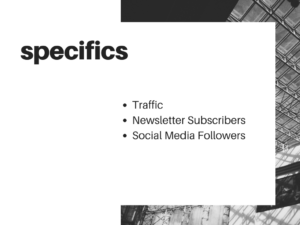
One of the biggest mistakes I see people making with their blog is either not having a call to action (CTA) or having a CTA that doesn’t match where the reader is in the buyer journey. If you’re working in a B2C space and/or selling something fairly low cost, you can have a CTA at the end of your blog post that directs readers to a sales page. But if you’re providing professional services or working in a B2B industry, you’re going to need more time to convince them they need your product/service and that they should buy from you rather than someone else, in which case your CTA might be to get them to sign up for your newsletter or follow you on social media.
Those are great content marketing goals, but they’re not very specific. How many newsletter subscribers/social media followers to you want to gain from a certain blog post?
Do you want it to drive a certain amount of traffic to your website? Maybe you’re using the blog post to drive traffic to another post or page on your website and so you’ll measure the success of that piece of content by the amount of traffic it drives to your other post/page. Don’t forget to be specific about the number of eyeballs (or ears if it’s audio content) you want seeing/listening to your content.
Measurable Content Marketing Goals

We talked about making sure your content marketing goals are specific, now let’s talk about how to measure the effectiveness of your content marketing campaigns to make sure you reached those goals. I think the easiest tool to use for that purpose is probably Google Analytics. It’s free and it tells you everything you want to know about how much traffic is going to your site, which pages they’re visiting, how long they’re sticking around before visiting another page or clicking away to another website, your bounce rate, etc.
If you wanted your blog post to drive traffic to a certain page on your website, Google Analytics can tell you how much traffic you got to that target post/page and whether it came from your latest blog post or another source.
If your goal was to rank on the first page of Google for a particular keyword, you can start by doing a Google search to see what comes up, but you can also see how much traffic came to your site via a particular keyword. Granted, there are a lot of factors there, including your headline and your excerpt. You might want to do some A/B testing of those to see which ones get the best results, but looking at the amount of traffic coming your website from a specific search term is a good place to start.
If your content marketing goal for a particular blog post was to get more people to sign up for your newsletter, you’ll need to check your CRM for that data. It will tell you whether your audience has grown, and if so, where those new subscribers came from. You can even use a specific form for a single piece of content to give you an idea of whether new subscribers are coming from that piece of content or somewhere else on your website.
Achievable Content Marketing Goals
We all want to rank on the first page of Google for every keyword we use, but let’s face it, that’s not a realistic goal for most of us. You can certainly work towards that goal as part of your overall SEO strategy, but if you’re just starting out, your achievable content marketing goals are going to be smaller, like driving a certain amount of traffic to your website.
If you’re just starting out and your website visitors are only in the double digits (or maybe even the single digits), then aiming for a single piece of content to drive thousands of visitors to your website is not an achievable goal. Instead, you might want to focus on doubling your traffic, or you might want to add 10 subscribers to your newsletter. I’m all for big goals that shoot for the moon, but many of us tend to get frustrated and give up when we don’t meet the high expectations we set for ourselves. That’s why we’re usually better off setting more achievable goals and working our way up towards the bigger goals.
Relevant Content Marketing Goals

Another problem a lot of business owners have is failing to make sure their content marketing goals are in alignment with their other marketing goals, which, in turn, have to be in alignment with their goals for their business as a whole.
This is why I place so much emphasis on identifying your target audience before creating any marketing content. You need to know the kinds of people with whom you want to work (and who want to work with you) before you can create content for them. You might find a keyword with some good KPIs while you’re doing your keyword research, but is your ideal client using that keyword as a search term? Is your content answering the questions they’re asking?
It’s important to keep the end goal in mind when creating content for your business, and it’s important to remember that driving traffic to your website is not the end goal, getting clients in the door is the end goal. Driving traffic to your website is certainly a step towards that end goal, but don’t make the mistake of trying to get more traffic without thinking about what you want those website visitors to do once they’ve found your website.
Time Sensitive Content Marketing Goals

I actually have trouble with this one because content marketing is a long game. It can take months for Google to index and categorize a piece of content before it starts showing up in online searches, and it can take a year or more before content marketing efforts really start to pay off in terms of showing up in online searches and converting leads, especially if you’re starting from scratch (i.e. launching a new website with a brand-new domain).
That said, not all your content marketing goals need to take months or years before you can expect to see results. Once you publish a blog post, you can use your newsletter and social media channels to drive traffic to that post, which will, in turn, give it an SEO boost because Google will note that traffic and take it to mean the content is valuable and answering people’s questions. So if your blog post has been up for a week, but still doesn’t have any traffic, that’s a problem.
It’s also important to remember that content marketing involves more than just your blog. It includes your newsletter and your social media content, and it’s much easier to measure the results of those efforts in a timely manner. For example, if you’re on Twitter, most of the people who are going to see a tweet have already seen it within the first 45 minutes after it’s been posted. Content on other social media posts is usually good for about a day, maybe two, and while I don’t recommend obsessively checking your social media stats every, single day, checking in once a week or so will give you a good idea of whether your social media strategy is working, or if you need to adjust.
The same goes for your newsletter, although I would let that one sit for at least a week because, while the middle of the week is usually the best time to send newsletters, some people let them sit until the weekend when they have more time to read them, so keep track of when your audience is opening your newsletter. Give it at least a week before you set your open rate and click-through rate in stone because if someone hasn’t opened your newsletter after a week, the chances that they’ll open it after that point decrease significantly.
If you found this content helpful and would like to receive more of it, you can sign up for our newsletter in the space below to make sure you never miss an update. You can also see what we’re up to by following us on LinkedIn, Twitter, YouTube and Facebook.
If you need help creating or assessing your content marketing goals, our content strategy services can help.
